Pericyclic
Advanced
Thermal 8π conrotatory then 6π disrotatory electrocyclisation cascade of an 11-membered oxacycle
Question
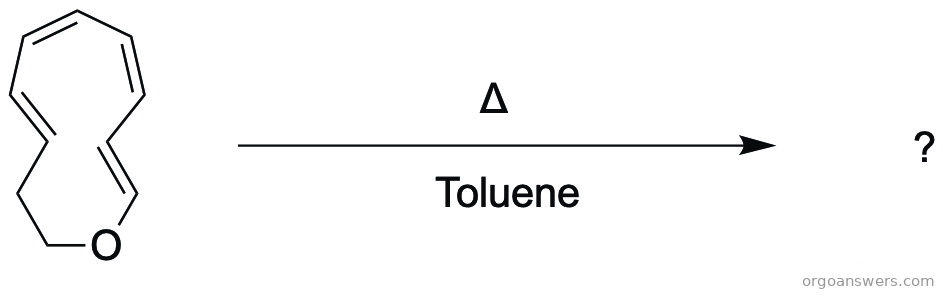
The 11-membered cyclic enol ether shown, a 2,3-dihydro-oxacycloundecine containing a conjugated tetraene, is heated and converts into the tricyclic product (3aS,3bR,7aR,7bS)-2,3,3a,3b,7a,7b-hexahydro-1-oxa-cyclopenta[3,4]cyclobuta[1,2]benzene. Draw the mechanism, showing (a) the thermal 8π electrocyclisation, including the bicyclic cyclooctatriene intermediate, and (b) the thermal 6π electrocyclisation that follows. State and justify the mode of ring closure (conrotatory or disrotatory) in each step using the Woodward-Hoffmann rules. Explain why the 8π step must come first, and why both new ring fusions are cis.
Question images
Expert answer
Step 1, 8π conrotatory closure: The tetraene termini (C7b and C3a) bond to each other, closing the five-membered ether ring and giving a fused cycloocta-1,3,5-triene. An 8π system has 4n electrons, so the thermal closure is conrotatory (termini rotate in the same direction).
Step 2, 6π disrotatory closure: The triene termini (C7a and C3b) bond to form the cyclobutane, leaving a diene in the six-membered ring (a bicyclo[4.2.0]octa-2,4-diene fused to the THF). A 6π system has 4n+2 electrons, so the thermal closure is disrotatory (termini rotate in opposite directions).
Order: The 8π step must come first, because the 6π step needs the cyclooctatriene it produces.
Stereochemistry: Both ring fusions are cis (a trans-fused 5/4 system is too strained, and disrotation gives the cis 6/4 fusion). The direction of rotation in each step sets your (3aS,3bR,7aR,7bS) descriptors.
Note: The final step is an equilibrium (cyclooctatriene ⇌ bicyclo[4.2.0]octadiene), favoured toward the cyclobutane here by the fused five-membered ring.