Organometallic
Advanced
Sonogashira coupling mechanism: 5-bromoindole and methyl propiolate
Question
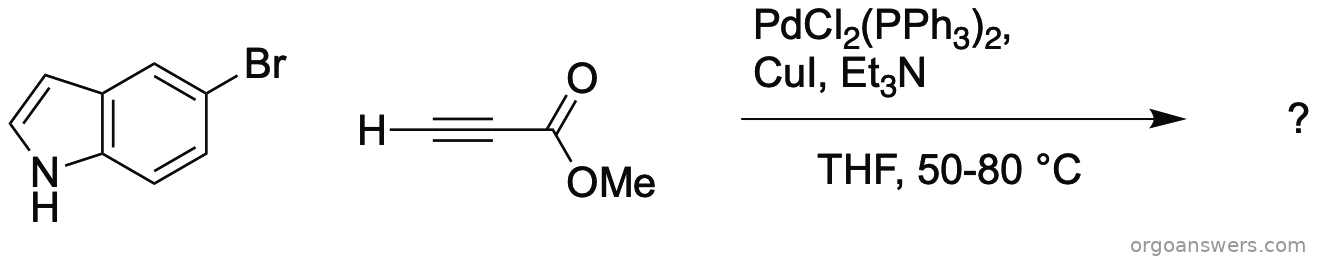
5-Bromoindole is heated with methyl propiolate in the presence of PdCl₂(PPh₃)₂, CuI and Et₃N under an inert atmosphere. Draw the mechanism of the Sonogashira coupling, including the activation of the Pd(II) pre-catalyst and both the palladium and copper cycles. Name each step, give the product, and explain why a copper co-catalyst and a base are needed.
Question images
Expert answer
The product is methyl 3-(1H-indol-5-yl)propiolate (methyl 3-(1H-indol-5-yl)prop-2-ynoate). The by-product is Et₃NH⁺ Br⁻.
Pre-catalyst activation (proposed): PdCl₂(PPh₃)₂ is Pd(II), so it must be reduced to Pd(0)L₂ (L = PPh₃, 14 electrons) before the cycle can start. A commonly proposed route is that two copper acetylides (formed from methyl propiolate, CuI and Et₃N) transmetalate onto Pd(II). Reductive elimination of the resulting cis-bis(alkynyl) complex then releases the 1,3-diyne, dimethyl hexa-2,4-diynedioate, and Pd(0)L₂. This consumes a little alkyne, but only 2-5 mol% Pd is used.
Copper cycle
π-complex formation (⇌): CuI coordinates to the C≡C of methyl propiolate, which makes the terminal C–H more acidic.
Deprotonation (⇌): Et₃N removes the proton to give the copper acetylide, Cu–C≡C–CO₂Me, and Et₃NH⁺ Br⁻. The ester makes this C–H especially acidic, so this step is easy.
Palladium cycle
3. Oxidative addition (→): Pd(0)L₂ inserts into the C–Br bond of 5-bromoindole to give ArPd(II)Br(L)₂ (16 electrons). Aryl bromides react more slowly than aryl iodides, so heating is needed.
4. Transmetalation (⇌): the alkynyl group transfers from copper to Pd, releasing CuBr, which re-enters the copper cycle. This gives ArPd(II)(C≡C–CO₂Me)(L)₂.
5. Trans-to-cis isomerisation (⇌): the aryl and alkynyl groups must be cis for the next step.
6. Reductive elimination (→): the new C(sp²)–C(sp) bond forms, releasing the product and regenerating Pd(0)L₂. Pd goes from +2 to 0.
Why copper is used: the copper acetylide forms under mild conditions, which makes transmetalation to Pd easy. Without copper, harsher conditions are needed (copper-free Sonogashira).
Why a base is needed: it deprotonates the alkyne (step 2) and takes up the HBr formed, so at least one equivalent is required.
Substrate notes
Homocoupling: oxygen promotes Glaser coupling of the alkyne to a diyne, which is why the reaction is run under N₂ with degassed solvent.
Electron-poor alkyne: propiolates can undergo conjugate addition by amines such as Et₃N, so a bulkier amine or copper-free conditions are sometimes used. Treat this as a possible side reaction, not a certain outcome.
Indole N–H: it’s often tolerated unprotected, but it can be protected (for example N-Boc) if needed.