Nucleophilic substitution
Introductory
SN2 substitution of 1-bromopropane with hydroxide
Question
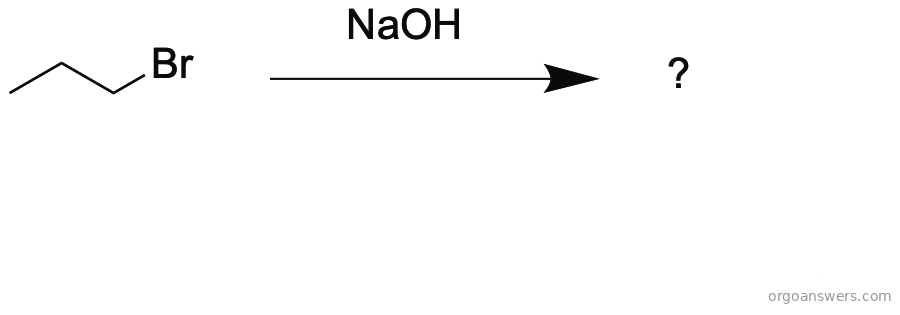
1-Bromopropane is treated with aqueous sodium hydroxide (NaOH). Draw the organic product and show the complete mechanism using curly arrows. Identify the mechanism and explain why it is favoured.
Question images
Expert answer
Product — propan-1-ol. Hydroxide replaces bromide, converting 1-bromopropane into propan-1-ol. Sodium bromide is the inorganic by-product.
Mechanism — SN2 nucleophilic substitution. The reaction occurs in one concerted step. A lone pair on OH⁻ attacks the carbon bonded to bromine from the side opposite the C–Br bond. At the same time, the C–Br bond breaks and its electron pair moves onto bromine, which leaves as Br⁻.
Transition state. The carbon is partially bonded to both OH and Br. Bond formation and bond breaking happen simultaneously, so no carbocation intermediate is formed.
Why SN2 is favoured. 1-Bromopropane is a primary halogenoalkane, so the reacting carbon is only lightly hindered and is accessible to backside attack. OH⁻ is also a strong nucleophile. The rate depends on both reactants: rate = k[1-bromopropane][OH⁻].