Organometallic
Intermediate
Ring-closing metathesis mechanism: 1,7-octadiene to cyclohexene
Question
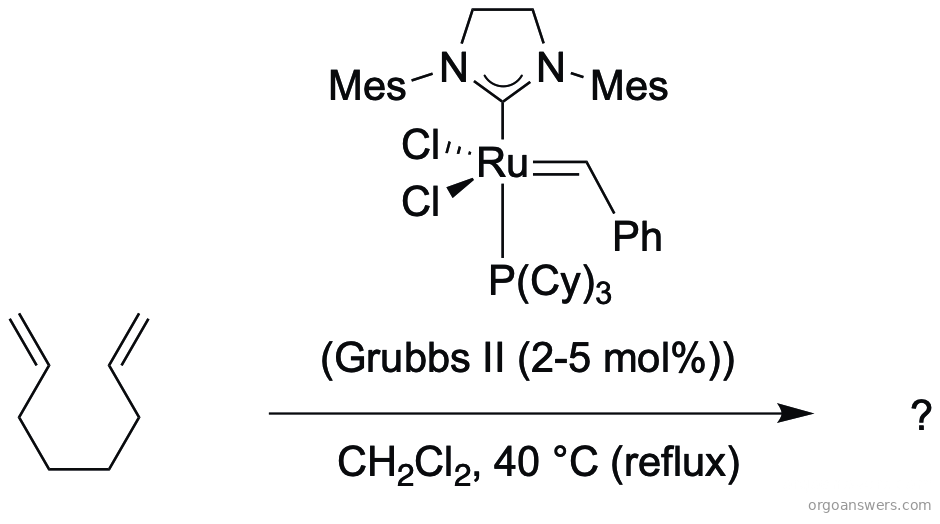
1,7-Octadiene is treated with Grubbs II catalyst (5 mol%) in dilute CH₂Cl₂ at 40 °C. Draw the mechanism for the ring-closing metathesis, naming each step, and give the products.
Question images
Expert answer
The products are cyclohexene and ethylene. The mechanism is the Chauvin mechanism, a series of [2+2] cycloadditions and retro-[2+2] cycloreversions through metallacyclobutane intermediates.
Initiation
Ligand dissociation (⇌): Grubbs II is a 16-electron Ru benzylidene, and one PCy₃ ligand dissociates to give the 14-electron active species. This is the generally accepted initiation step.
[2+2] cycloaddition (⇌): one terminal alkene of the diene binds to Ru and forms a metallacyclobutane with the Ru=CHPh bond.
Retro-[2+2] (⇌): the metallacyclobutane opens the other way, releasing styrene (PhCH=CH₂) and giving a new Ru alkylidene attached to the substrate chain.
Ring closure
4. Intramolecular [2+2] cycloaddition (⇌): the second alkene of the same molecule binds to Ru and forms a second metallacyclobutane. This is the ring-closing step.
5. Retro-[2+2] (⇌): this metallacyclobutane opens to release cyclohexene and Ru=CH₂.
Turnover
6. Ru=CH₂ reacts with another molecule of 1,7-octadiene by [2+2] and retro-[2+2], releasing ethylene and regenerating the substrate-bound alkylidene, so the cycle repeats.
What drives it: every step is reversible, so draw ⇌ throughout. The driving force is the loss of ethylene gas (entropy and Le Chatelier’s principle). The Ru oxidation state doesn’t change during the cycle.
Why dilute conditions: at high concentration, intermolecular metathesis competes and gives oligomers or polymer. Dilution (0.01-0.05 M) favours the intramolecular ring closure.