Heterocyclic
Advanced
Pictet-Spengler isoquinoline synthesis: mechanism with DDQ aromatisation
Question
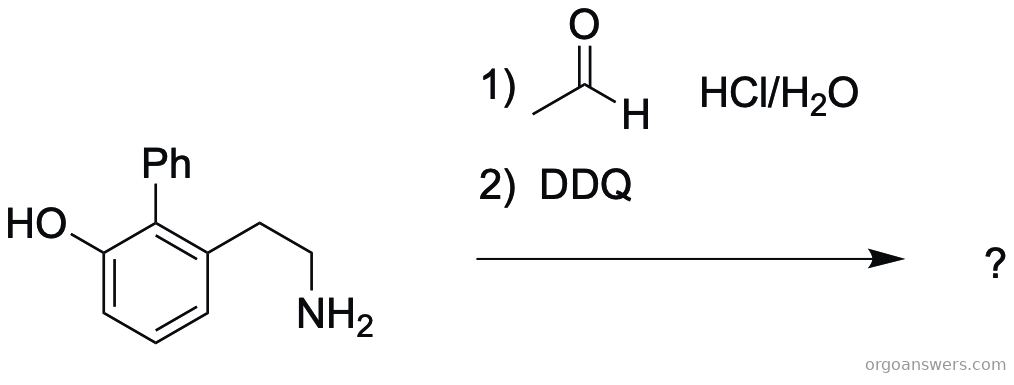
3-(2-Aminoethyl)-2-phenylphenol is treated with ethanal in aqueous HCl, and the product is then oxidised with excess DDQ. Draw the complete Pictet-Spengler mechanism, using H₂O as the base for each deprotonation. Show the iminium ion, the 6-endo-trig ring closure and the rearomatisation, and state which steps are reversible. Explain why the hydroxyl group makes the cyclisation favourable and why only one ring position can close. Then show the DDQ oxidation and give the final product.
Question images
Expert answer
The Pictet-Spengler step gives 1-methyl-5-phenyl-1,2,3,4-tetrahydroisoquinolin-6-ol. DDQ then oxidises it to 1-methyl-5-phenylisoquinolin-6-ol.
Step 1, hemiaminal formation (⇌): the amine adds to the carbonyl of ethanal, and proton transfer gives the hemiaminal.
Step 2, iminium formation (⇌, −H₂O): the OH is protonated and leaves as water. Acid protonates the resulting imine, giving the electrophilic iminium ion.
Step 3, ring closure (⇌): the aromatic carbon para to the OH attacks the iminium carbon in a 6-endo-trig electrophilic aromatic substitution. The OH lone pair pushes into the ring and stabilises the intermediate (an oxocarbenium-type Wheland intermediate), which is why the reaction works in aqueous acid. Only one position can close, because the phenyl group occupies the other ortho position next to the chain.
Step 4, rearomatisation (⇌): loss of H⁺ to water restores the aromatic ring, giving the tetrahydroisoquinoline.
Step 5, DDQ oxidation (→): DDQ abstracts hydride from C1–H, the benzylic position next to nitrogen. The N lone pair and the OH (para to the ring carbon C8a) both stabilise the resulting cation, so this is easy. DDQ becomes the aromatic hydroquinone anion. Loss of N–H⁺ gives the 3,4-dihydroisoquinoline. With excess DDQ, further dehydrogenation (removal of H₂ from C3–C4) gives the fully aromatic isoquinoline, and aromatisation is the driving force.
Which steps are reversible: steps 1 to 4 are equilibria. The oxidation is irreversible.