Heterocyclic
Intermediate
Paal-Knorr furan synthesis: acid-catalysed cyclisation of heptane-2,5-dione
Question
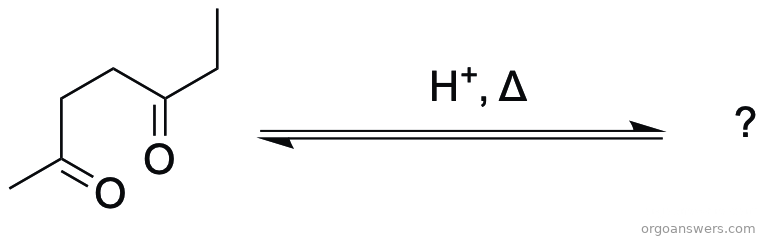
Heptane-2,5-dione is heated with a catalytic amount of p-toluenesulfonic acid in toluene under Dean-Stark conditions. Predict the product and draw the complete Paal-Knorr mechanism, showing the cyclisation to the hemiketal and the loss of water. State which steps are reversible, and explain why the reaction is run with continuous removal of water and why dilute aqueous acid would take the furan back to the diketone. Explain why the unsymmetrical diketone gives only one furan.
Question images
Expert answer
The product is 2-ethyl-5-methylfuran (C₇H₁₂O₂ → C₇H₁₀O + H₂O). The reaction is an acid-catalysed cyclodehydration of a 1,4-diketone, and every step is reversible.
Step 1, protonation (⇌): H⁺ protonates one carbonyl oxygen, making that carbon more electrophilic (δ+).
Step 2, enolisation (⇌): The other ketone tautomerises to its enol, giving the oxygen a nucleophilic lone pair. It must enolise towards the inner CH₂ of the chain (C4, for the C5 ketone). Enolising towards the outer CH₃ or CH₂CH₃ would put the oxygen too far from the other carbonyl to close a five-membered ring.
Step 3, ring closure (⇌): The enol oxygen attacks the protonated carbonyl carbon in a 5-exo-trig cyclisation. Loss of a proton gives the cyclic hemiketal, a 2-hydroxy-2,3-dihydrofuran.
Step 4, loss of water (⇌): The OH is protonated and leaves as water, assisted by the ring oxygen’s lone pair, giving a resonance-stabilised oxocarbenium ion.
Step 5, deprotonation (⇌): Loss of H⁺ from the adjacent ring CH₂ gives the aromatic furan.
Why only one furan forms: either carbonyl can act as the protonated electrophile and the other as the enol, but both routes lead to the same ring, with the methyl group at one α-position and the ethyl group at the other. The product is 2-ethyl-5-methylfuran either way, so there’s no regiochemistry to resolve.
Why every step is an equilibrium: furan has the weakest aromatic stabilisation of the common five-membered heterocycles, so the aromatic gain is small. In dilute aqueous acid the furan is protonated and ring-opens, and water adds back to give the 1,4-diketone. The forward and reverse reactions follow the same pathway in opposite directions.
What drives it forward: Le Chatelier’s principle. Removing water with a Dean-Stark trap (or a dehydrating agent such as P₂O₅) pulls the equilibrium towards furan, and the modest aromatic stabilisation helps keep it there.
Contrast with the pyrrole version: with an amine, the aromatic pyrrole is much more stable, so the dehydration steps are effectively irreversible and hydrolysis isn’t a practical problem.