Pericyclic
Advanced
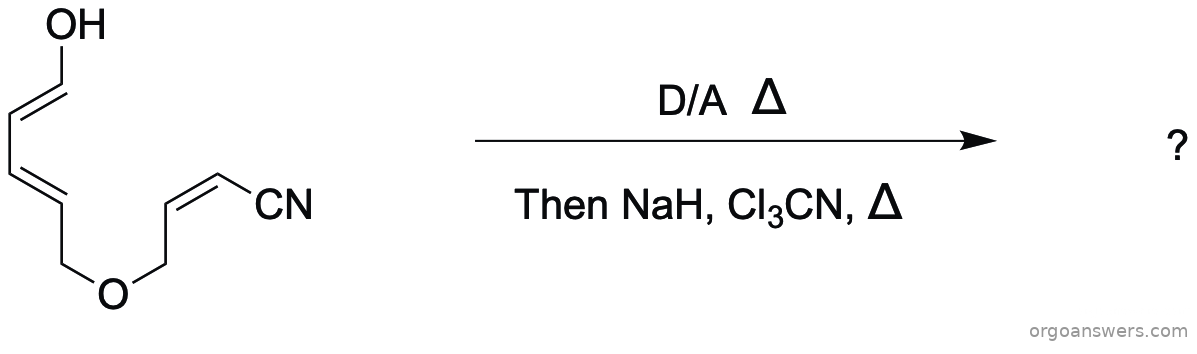
Intramolecular Diels-Alder of an ether-tethered diene followed by [3,3]-sigmatropic Aza-Claisen (Overman) rearrangement
Question
Ether-tethered diene is heated to give a bicyclic cycloadduct containing a secondary allylic alcohol. This alcohol is then treated with trichloroacetonitrile (Cl₃CCN) and a catalytic amount of base, followed by heating. Draw the complete mechanism for the sequence, showing (a) the intramolecular Diels-Alder reaction and the tether geometry that determines the ring fusion, (b) formation of the trichloroacetimidate from the alcohol, and the [3,3]-sigmatropic Overman rearrangement through its chair-like transition state. Identify the final product, explain why the rearrangement is thermodynamically driven, and state what happens to the stereochemistry at the carbon bearing oxygen.
Question images
Expert answer
Step 1, intramolecular Diels-Alder: The diene and dienophile are connected by a short tether, so the [4+2] cycloaddition is a concerted, single-step process through a cyclic transition state. It is faster and more selective than the intermolecular version because the tether removes most of the entropic cost, since the two reacting partners are already held close together. The tether geometry determines the ring fusion (cis or trans) and the relative stereochemistry. The new cyclohexene contains an allylic alcohol.
Step 2, imidate formation: The base deprotonates the alcohol to give an alkoxide, which attacks the nitrile carbon of Cl₃CCN. The CCl₃ group is strongly electron-withdrawing, which makes this carbon unusually electrophilic. Proton transfer gives the O-allyl trichloroacetimidate. Only a catalytic amount of base is needed, because the nitrogen anion deprotonates another molecule of alcohol and continues the cycle.
Step 3, Overman rearrangement: The imidate undergoes a [3,3]-sigmatropic rearrangement (a 1-aza-Claisen type process) through a six-membered, chair-like transition state. The C–O bond breaks while a new C–N bond forms at the opposite end of the allyl system, so the alkene transposes. The product is an allylic trichloroacetamide. The reaction is driven by conversion of the C=N bond into a very stable amide C=O, so it is effectively irreversible. Heating (about 140 °C) is usually required, though Pd(II) or Hg(II) catalysts allow it at room temperature.
Stereochemistry: The rearrangement is suprafacial, so chirality transfers from the C–O stereocentre to the new C–N stereocentre. The nitrogen is delivered to the same face of the alkene that the oxygen occupied. This is why the sequence is so useful for installing nitrogen stereospecifically.