Organometallic
Advanced
Heck reaction mechanism: bromobenzene and ethyl acrylate
Question
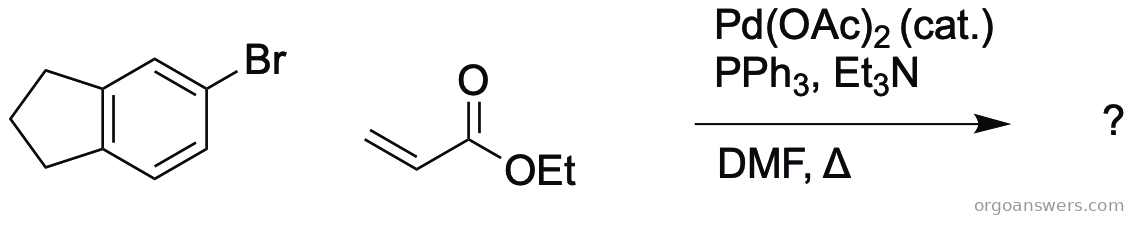
Bromobenzene reacts with ethyl acrylate using a Pd(0) catalyst and a base. Draw the catalytic cycle for the Heck reaction, name each step and give the product.
Question images
Expert answer
Catalyst activation: a Pd(II) pre-catalyst such as Pd(OAc)₂ is reduced in situ to the active Pd(0)L₂ (proposed: a phosphine ligand is oxidised to the phosphine oxide).
he product is ethyl (E)-cinnamate, PhCH=CHCO₂Et. The by-product is Et₃NH⁺ Br⁻.
Catalyst activation: a Pd(II) pre-catalyst such as Pd(OAc)₂ is reduced in situ to the active Pd(0)L₂, where L is PPh₃ (proposed: one phosphine is oxidised to the phosphine oxide).
Catalytic cycle
Oxidative addition (→): Pd(0)L₂ inserts into the C–Br bond of bromobenzene to give PhPd(II)Br(L)₂. This is slower for Ar–Br than for Ar–I, so heat is needed.
Alkene coordination (⇌): a ligand leaves, and ethyl acrylate binds to Pd.
Syn migratory insertion (→): the phenyl group migrates to the terminal CH₂ of the acrylate (the less hindered carbon), and Pd bonds to the carbon bearing CO₂Et.
C–C rotation: this puts a β-hydrogen syn to Pd.
Syn β-hydride elimination (⇌): this forms the C=C bond and a Pd–H species. The less hindered conformer, with Ph and CO₂Et trans, gives the E alkene. The product then dissociates from Pd.
Base-assisted regeneration (→): Et₃N removes HBr from H–Pd–Br(L)₂, regenerating Pd(0)L₂.