Heterocyclic
Advanced
Hantzsch synthesis of diphenyl 2,6-dimethylpyridine-3,5-dicarboxylat
Question
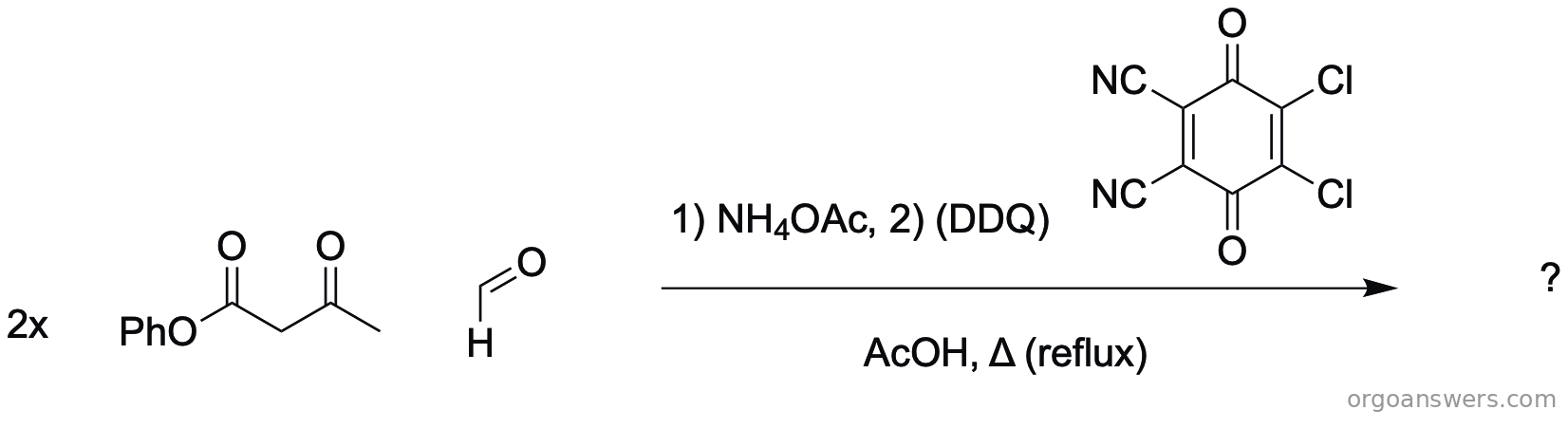
Phenyl acetoacetate (2 equiv.) is heated with formaldehyde and ammonium acetate in ethanol. The dihydropyridine formed is then oxidised with DDQ. Draw the complete Hantzsch mechanism, showing (a) the aldol-type condensation of formaldehyde with one equivalent of the ketoester, (b) enamine formation from the second equivalent, the formal [3+3] annulation of the two intermediates to give the 1,4-dihydropyridine, and (d) the DDQ oxidation. Give the final product, state which steps are reversible, and explain what drives the sequence.
Question images
Expert answer
The final product is diphenyl 2,6-dimethylpyridine-3,5-dicarboxylate, formed via diphenyl 2,6-dimethyl-1,4-dihydropyridine-3,5-dicarboxylate.
Step 1, aldol-type (Knoevenagel) condensation (⇌, −H₂O): the enol or enolate of phenyl acetoacetate attacks the carbonyl of formaldehyde. Dehydration gives the alkylidene, phenyl 2-methylene-3-oxobutanoate, a very reactive Michael acceptor. Formaldehyde has no α-hydrogens, so it can’t self-condense and acts only as the electrophile.
Step 2, enamine formation (⇌, −H₂O): ammonia adds to the ketone of the second equivalent of phenyl acetoacetate. Loss of water gives the β-enamino ester, phenyl 3-aminobut-2-enoate. Its α-carbon is nucleophilic.
Step 3, formal [3+3] annulation (⇌, then →): the enamine α-carbon attacks the alkylidene’s CH₂ terminus in a Michael addition. The NH₂ then attacks the ketone carbonyl and ring closure gives a six-membered cyclic hemiaminal. Dehydration gives the 1,4-dihydropyridine. This is a formal [3+3] because the N–C=C unit and the CH₂=C–C=O unit each contribute three atoms to the ring, but it’s stepwise (Michael addition, then cyclodehydration) and not a concerted pericyclic reaction. The final dehydration is effectively irreversible, as it forms the conjugated dihydropyridine.
Step 4, oxidation (→): DDQ removes a hydride from C4–H, giving a pyridinium cation, and loss of the N–H proton gives the aromatic pyridine. DDQ becomes the hydroquinone (DDQH₂). This step is irreversible, and aromatisation is the driving force.
What drives the sequence: condensation and cyclisation are reversible, and loss of water pulls them forward. Oxidation of the dihydropyridine is the irreversible step that locks in the aromatic product.