Elimination
Introductory
E2 elimination of chlorocyclohexane with hydroxide
Question
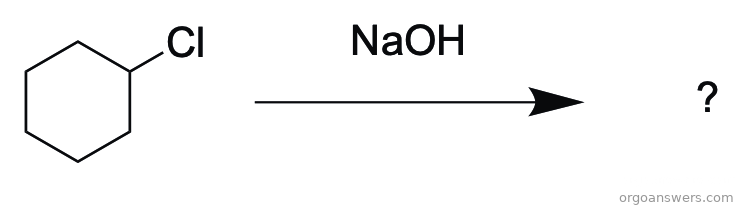
Chlorocyclohexane is heated with sodium hydroxide (NaOH). Draw the organic product and show the complete elimination mechanism using curly arrows. Identify the mechanism and explain the required geometry.
Question images
Expert answer
Product — cyclohexene. Hydroxide removes a β-hydrogen from a carbon adjacent to the carbon bearing chlorine. The C–H electrons form the C=C bond as chloride leaves, producing cyclohexene, water and sodium chloride.
Mechanism — E2 elimination. This is a single concerted step: OH⁻ acts as a base, the β C–H bond breaks, the C=C π bond forms and the C–Cl bond breaks at the same time. There is no carbocation intermediate.
Required geometry. Efficient E2 elimination requires the β-hydrogen and C–Cl bond to be anti-periplanar. In a cyclohexane chair this means a trans-diaxial arrangement, so the reactive conformer has both the leaving group and the selected β-hydrogen axial.
Why E2 is favoured. Hydroxide is a strong base, and heating favours elimination. Either adjacent β-carbon gives the same cyclohexene product because chlorocyclohexane is symmetrical. The rate depends on both reactants: rate = k[chlorocyclohexane][OH⁻].