Pericyclic
Advanced
Diels-Alder of 1-methoxy-3-methylpenta-1,3-diene with acrylonitrile
Question
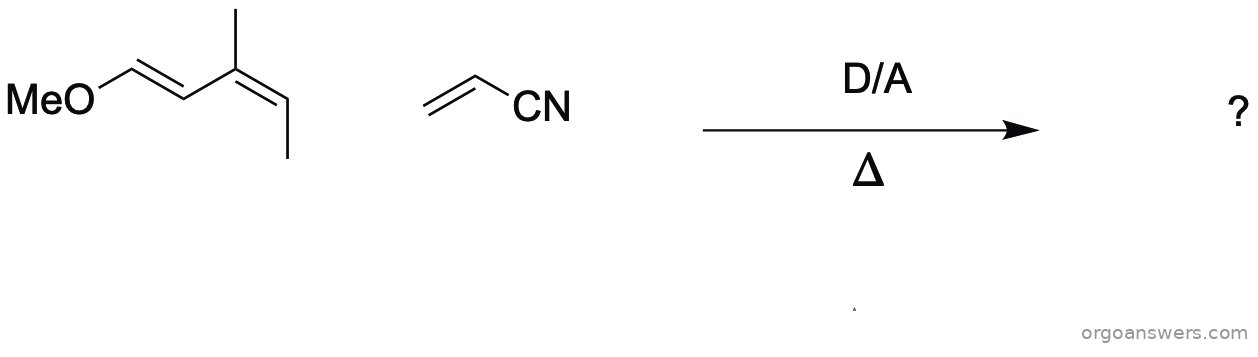
1-Methoxy-3-methylpenta-1,3-diene reacts with acrylonitrile via a Diels-Alder [4+2] cycloaddition on heating. Draw the mechanism, showing the required s-cis conformation of the diene and the cyclic transition state. Using resonance (FMO) arguments, predict and explain the regiochemistry of the major product — i.e. the relative positions of the methoxy, methyl and nitrile groups on the resulting cyclohexene ring.
Question images
Expert answer
This is a normal electron demand Diels-Alder reaction. The diene is strongly activated by the 1-methoxy group, a powerful π-donor, while acrylonitrile is activated as the dienophile by the electron-withdrawing nitrile group.
The diene must first adopt the s-cis conformation to allow both terminal carbons to align with the dienophile's alkene in the concerted, six-membered cyclic transition state. All bonds form and break simultaneously — there is no discrete intermediate.
Regiochemistry is governed by the partial charges set up by the electron-donating and electron-withdrawing groups. The methoxy group donates electron density into the diene π system, placing the largest partial negative charge (δ−) at C4, the diene's far terminal carbon. The nitrile group withdraws electron density from acrylonitrile, leaving its β-carbon with a partial positive charge (δ+). These complementary partial charges direct bonding: the diene's δ− carbon bonds preferentially to the dienophile's δ+ carbon, giving the "para-like" regiochemical outcome characteristic of 1-substituted dienes reacting with mono-substituted dienophiles.
Stereochemistry is governed separately by Alder's endo rule. Secondary orbital interactions between the nitrile's π* orbital and the diene's π system stabilise the endo transition state relative to the exo approach, so the endo product is favoured kinetically, even though it may not be the thermodynamically most stable diastereomer.