Organometallic
Advanced
Buchwald-Hartwig N-arylation of a benzimidazole: Pd-catalysed C–N coupling of an aryl bromide
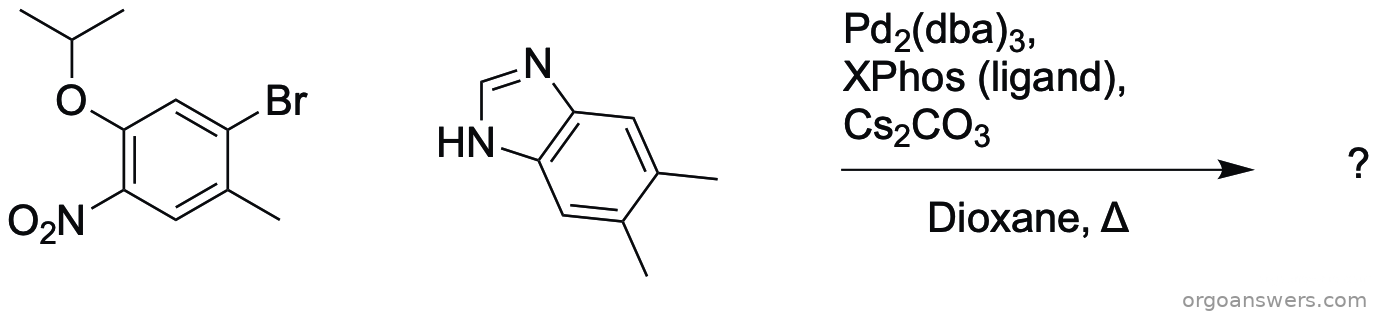
Question
An electron-poor aryl bromide (Ar–Br) is heated with 5,6-dimethyl-1H-benzimidazole in the presence of Pd₂(dba)₃, XPhos and Cs₂CO₃ in dioxane. Draw the Buchwald-Hartwig catalytic cycle, including how the active catalyst is generated from Pd₂(dba)₃. Name each step and give the product. Explain (a) why a base is needed and (b) why only one N-arylated product is formed.
Question images
Expert answer
The product is the N-aryl benzimidazole, 1-Ar-5,6-dimethyl-1H-benzimidazole. The by-products are CsBr and CsHCO₃.
Catalyst generation: Pd₂(dba)₃ is already a Pd(0) source, so no reduction is needed. The bulky biaryl phosphine XPhos (L) displaces dba (⇌), giving the monoligated active catalyst LPd(0).
Catalytic cycle
Oxidative addition (→): LPd(0) inserts into the Ar–Br bond to give LPd(II)(Ar)Br. Pd goes from 0 to +2. Electron-withdrawing groups on the aryl ring, such as NO₂, speed this step up.
Azole coordination (⇌): the imine-type nitrogen (N3, the one with the available lone pair) binds to Pd, while the N1–H stays intact.
Deprotonation (⇌): Cs₂CO₃ removes the N–H proton, giving the Pd(II)–azolide complex LPd(II)(Ar)(azolide) and releasing the bromide as CsBr.
Reductive elimination (→): the new C–N bond forms, releasing the product and regenerating LPd(0). Pd goes from +2 to 0. Bulky ligands such as XPhos typically accelerate this step.
Why a base is needed: it deprotonates the benzimidazole N–H (step 3) to give the Pd–azolide that can reductively eliminate, and it takes up the HBr formed. Cs₂CO₃ is a mild base, and with a nitro-substituted aryl bromide it’s typically a safer choice than a strong alkoxide such as NaOt-Bu, though I haven’t verified that for this substrate.
Why only one product: 5,6-dimethylbenzimidazole is symmetric, so N1 and N3 are equivalent (the two tautomers are identical). Arylation at either nitrogen gives the same compound. An unsymmetrical benzimidazole would give a mixture of regioisomers.
Why XPhos: it’s a bulky, electron-rich biaryl phosphine. It stabilises the monoligated LPd(0) species, and it promotes both oxidative addition and reductive elimination.