Aldol Condensation
Advanced
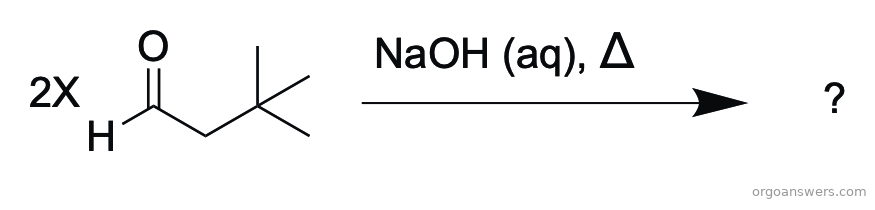
Aldol condensation of 3,3-dimethylbutanal
Question
3,3-Dimethylbutanal is treated with dilute NaOH(aq) and gently warmed. Draw the mechanism for the base-catalysed aldol condensation, showing (i) enolate formation, (ii) the aldol addition step to form the β-hydroxy aldehyde intermediate, and (iii) the E1cb dehydration step that gives the final α,β-unsaturated aldehyde product. Explain why the bulky tert-butyl group influences which α-carbon is deprotonated.
Question images
Expert answer
This is a base-catalysed self-aldol condensation. 3,3-Dimethylbutanal has only one accessible α-carbon — the CH₂ adjacent to the carbonyl — since the other neighbouring carbon is the fully substituted quaternary C(CH₃)₃ group with no hydrogens available for deprotonation. This removes any regiochemical ambiguity: enolisation can only occur at the single available α-position.
Dilute NaOH deprotonates this α-CH₂ to form a resonance-stabilised enolate. The enolate then acts as a nucleophile, attacking the electrophilic carbonyl carbon of a second molecule of 3,3-dimethylbutanal in the aldol addition step — this step is reversible (shown with an equilibrium arrow), forming a β-hydroxy aldehyde intermediate.
Under the basic, heated conditions, this intermediate undergoes E1cb elimination: a proton α to the carbonyl is removed to form a stabilised carbanion/enolate, which then expels hydroxide to form the conjugated α,β-unsaturated aldehyde product. The formation of this conjugated system provides the thermodynamic driving force for dehydration.